


The best family game rooms are designed for more than one kind of player. A good space can handle a lively board game, a relaxed movie night, a few rounds of video games, and an impromptu competition without feeling like every inch has to be dedicated to entertainment equipment.
These family game room ideas focus on flexible layouts, comfortable seating, smart storage, and activities that work for different ages. You can use a basement, spare bedroom, loft, bonus room, or even one section of a larger living area to create a space your family will actually use.
16 Family Game Room Ideas at a Glance
- Flexible Multi-Zone Game Room
- Family Board Game Library
- Cozy Video Game Lounge
- Fold-Away Game Table Station
- Retro Arcade Corner
- Indoor Sports Zone
- Movie Night and Gaming Hub
- Colorful Kids-and-Adults Game Room
- Built-In Game Storage Wall
- Family Tournament Station
- Snack and Drink Bar
- Basement Game Room With Lounge Seating
- DIY Personalized Game Wall
- Reading and Quiet Game Corner
- Convertible Dining and Game Room
- Family Game Night Lounge
How to Plan a Family Game Room
Before buying furniture or gaming equipment, think about how your family actually spends time together. A room filled with large game tables may look exciting but become difficult to use if there is nowhere comfortable to sit, store snacks, or move around.
| Priority | Good Choice | Why It Helps |
|---|---|---|
| Small room | Folding tables and wall storage | Keeps the floor open for multiple activities |
| Mixed ages | Multiple activity zones | Everyone can choose an activity without competing for one area |
| Board game fans | Large table and organized shelving | Makes setup, play, and cleanup easier |
| Video game fans | TV wall and lounge seating | Creates a shared screen experience |
| Frequent gatherings | Flexible seating and snack storage | Makes the room work for larger groups |
16 Unique Family Game Room Ideas
1. Flexible Multi-Zone Game Room
Instead of designing the entire room around one game, divide it into a few smaller activity zones. Place a central table for board games and puzzles, a TV with comfortable seating along one wall, and an open area for active games.
A low bookcase or open shelving unit can subtly separate the zones without making the room feel divided.
Keep the center of the room relatively open so people can move between activities. This layout is particularly useful for families with children and adults who enjoy different types of games.

Amazon Find: Cube Storage Organizer
Open cube storage makes it easy to separate board games, controllers, puzzles, books, and smaller accessories while keeping frequently used items within reach.

2. Family Board Game Library
Make board games the star of the room by creating a dedicated game library. Arrange boxes vertically on sturdy shelves and group them by type or age range so everyone can find something quickly. Use baskets or small containers for cards, dice, timers, pencils, and loose pieces.
Place a generously sized table nearby with enough elbow room for several players. A warm pendant or ceiling fixture directly over the table can make this corner feel like a destination rather than simply another dining area.

3. Cozy Video Game Lounge
A family video game area does not have to look like a dedicated gaming studio. Use a comfortable sofa, compact lounge chairs, or floor cushions facing a wall-mounted TV. Add a small media console underneath for consoles and accessories, then keep controllers organized in one accessible spot.
For a softer family-room feel, choose neutral furniture and introduce gaming personality through artwork, colorful pillows, shelving, or subtle LED lighting. This makes the area comfortable for gaming, watching movies, and simply hanging out.

Amazon Find: Controller Storage Organizer
A dedicated controller organizer keeps the TV console area tidy and gives every accessory a predictable home after family game night.

4. Fold-Away Game Table Station
If your game room also needs to serve another purpose, choose a table that can be folded, moved, or repurposed. A folding ping-pong table can provide active entertainment and then be stored or folded when the family needs more floor space. A folding card table can work for board games, crafts, puzzles, or homework.
Store the table against a wall when it is not being used and keep lightweight chairs nearby. This is a particularly practical solution for smaller bonus rooms and multipurpose spaces.

5. Retro Arcade Corner
Give one corner of the family game room a nostalgic arcade feel instead of turning the entire room into a theme space. A compact arcade cabinet, framed vintage-inspired artwork, and a simple neon-style sign can establish the look without overwhelming the rest of the decor.
Use a small stool or narrow bench nearby rather than bulky seating. A dark wall behind the arcade can make the machine stand out, while warmer wood furniture elsewhere keeps the overall room comfortable for everyday family use.

Amazon Find: Gaming Room LED Sign
A small LED sign can add personality to an arcade corner without requiring a complete themed makeover.

6. Indoor Sports Zone
Add an active component for family members who would rather move than sit. Depending on the room, you could include a compact foosball table, tabletop basketball game, foldable ping-pong setup, or another age-appropriate indoor activity.
Leave enough clearance around active equipment and keep walkways separate from areas where people are sitting. For younger children, select equipment designed for their age and supervise activities that involve moving pieces or balls.

7. Movie Night and Gaming Hub
Combine movie nights and gaming in one comfortable entertainment wall. Mount a TV at a practical viewing height, place the console equipment below it, and arrange a sofa or sectional directly opposite. Add a projector only if the room and viewing distance support it comfortably.
Blackout curtains can help when the room receives a lot of daylight, while a rug and upholstered seating add softness. Keep lighting dimmable so the room can switch easily between everyday use and movie night.

Amazon Find: Dimmable Game Room Lighting
Dimmable lighting lets you keep enough illumination for board games while creating a softer atmosphere for movies and console gaming.

8. Colorful Kids-and-Adults Game Room
Create a room that feels playful enough for children without looking like a preschool classroom. Start with a neutral base such as warm white, light gray, or natural wood, then introduce brighter colors through rugs, cushions, artwork, storage bins, and game accessories.
Choose durable, easy-to-clean surfaces and furniture with rounded edges where appropriate. Open shelves placed at accessible heights can give children more independence while keeping adult-sized equipment higher or secured as needed.

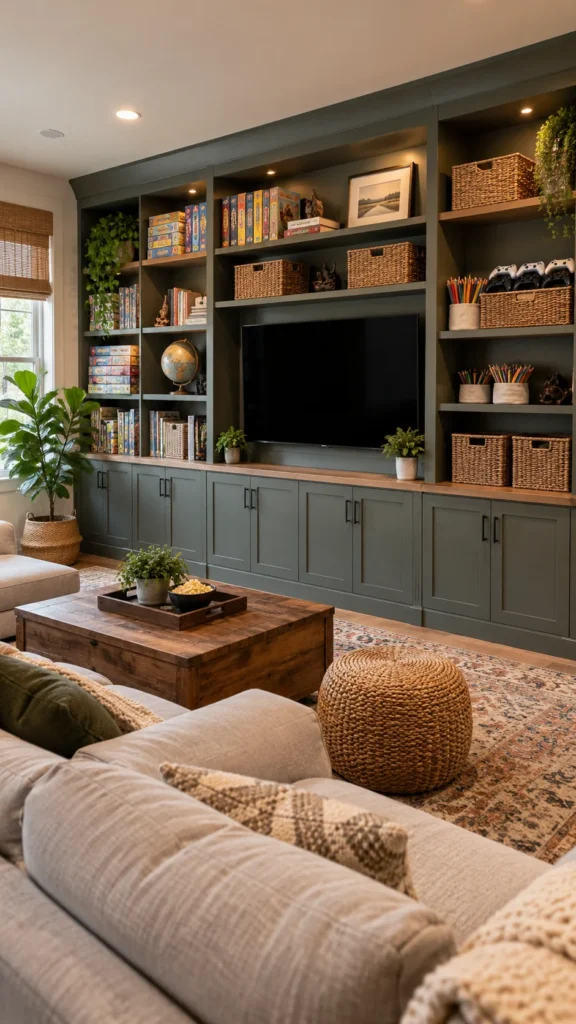
9. Built-In Game Storage Wall
Turn one wall into the organizational backbone of the room. A combination of closed cabinets, open shelves, and labeled baskets can hold everything from board games and puzzles to controllers, chargers, remotes, and craft supplies.
Keep attractive items on open shelving and hide visual clutter behind cabinet doors. If built-ins are outside your budget, combine modular cube storage with matching baskets to create a similar wall-to-wall effect.
Amazon Find: Labelled Storage Bins
Labeled bins are useful for separating dice, cards, controllers, craft materials, puzzle pieces, and other small game-room accessories.

10. Family Tournament Station
Make game night feel special with a dedicated tournament area. A large table can host card games and board games, while a nearby chalkboard, whiteboard, or framed scoreboard gives you a place to record family scores.
Keep the scoreboard simple enough to update quickly. A small shelf can hold prizes, rotating game-night picks, or a container of playing cards. The point is to make the room feel ready for an activity rather than creating a complicated competition system.

11. Snack and Drink Bar
A small snack station can make the game room much more convenient during longer family gatherings. Use a narrow console, rolling cart, or compact cabinet to hold cups, napkins, individually portioned snacks, and a few everyday drinks.
Choose a surface that is easy to wipe clean and keep food away from sensitive electronics. A lidded trash bin nearby can also prevent wrappers and cups from accumulating around the seating area.

Amazon Find: Rolling Utility Cart
A rolling cart can serve as a movable snack station, game accessory cart, or temporary storage area when the room layout changes.

12. Basement Game Room With Lounge Seating
A basement can become a comfortable family game room when you balance entertainment equipment with inviting lounge furniture. Start with a sectional or several movable chairs, then position a game table or TV zone where it will not interrupt the main walkway.
If the basement tends to feel cool or echoey, use area rugs, curtains, upholstered seating, and soft textiles to add warmth. Before finishing a basement, address any moisture, ventilation, electrical, and safety considerations appropriate to the space.

13. DIY Personalized Game Wall
Give the room a personal identity with a wall that celebrates your family’s favorite games. Frame old game boards, display colorful cards in shadow boxes, hang homemade scoreboards, or create a simple gallery of family game-night photos.
For an affordable approach, use inexpensive frames in the same finish and vary the artwork inside them. You can also paint one accent wall in a rich color and let the smaller decorative pieces provide the personality.

14. Reading and Quiet Game Corner
Not everyone wants a loud or competitive activity all the time. Add a quieter corner with a comfortable reading chair, floor cushion, small bookshelf, and a basket of puzzles or solo games. This gives family members a place to relax while still being part of the shared room.
A floor lamp or adjustable reading light can make this corner functional without brightly illuminating the entire room. Use a small rug to visually distinguish it from the more active areas.

15. Convertible Dining and Game Room
If your home does not have a dedicated game room, let a dining or multipurpose room do double duty. A sturdy dining table can become the main board-game surface after dinner, while a nearby cabinet stores games and accessories.
Choose stackable or lightweight chairs that can be moved when needed. A sideboard can hide controllers and equipment, while decorative baskets can make game storage blend naturally with the rest of the room.

16. Family Game Night Lounge
Design the whole room around gathering together rather than a particular game. Arrange comfortable seating in a loose circle or U-shape so players can see one another, then keep a central coffee table or ottoman available for cards, snacks, and smaller games.
Add a soft rug, warm lighting, a few family photos, and a storage basket for blankets. This approach creates a room that feels just as appropriate for conversation and movie night as it does for a competitive round of cards.

Family Game Room Shopping Checklist
Essentials:
- Comfortable seating appropriate for the number of regular players
- A sturdy central table or flexible gaming surface
- Accessible storage for board games and accessories
- Good general lighting plus task lighting where needed
- A clear walking path between major activity areas
- Safe, organized cable management for electronics
Optional additions:
- LED accent lighting
- Arcade or tabletop games
- Snack cart or beverage station
- Projector or larger entertainment screen
- Scoreboard or family tournament wall
- Theme-specific artwork and decor
Whenever possible, choose furniture that can serve more than one purpose. A storage ottoman can provide seating and hide games, while a folding table can support board games one evening and crafts or homework another day.
Common Family Game Room Mistakes to Avoid
- Filling the room with oversized equipment: Leave enough open floor space to walk comfortably and change activities.
- Ignoring storage: Every frequently used game should have an obvious place to return after play.
- Using only one type of seating: A mixture of sofa seating, chairs, and movable cushions can accommodate different preferences.
- Making lighting too dark: Ambient lighting is fun, but board games and puzzles still need adequate illumination.
- Letting cables cross walkways: Route electronic cables along walls or through appropriate cable-management solutions.
- Overcommitting to one theme: A few coordinated decorative pieces can create personality without making the room difficult to update.
- Forgetting age differences: Keep younger children’s equipment accessible while securing unsuitable equipment, cords, or small pieces as appropriate.
Amazon Find: Cable Management Kit
Cable clips, sleeves, and organizers can help keep TV, console, charging, and speaker cables grouped neatly instead of spreading across the floor.

Family Game Room FAQs
1. What should every family game room have?
Start with comfortable seating, a suitable playing surface, accessible storage, good lighting, and enough open space to move around. After those basics are covered, add the games and technology your family actually enjoys instead of filling the room with equipment that rarely gets used.
2. How can I make a small family game room work?
Use vertical storage, folding tables, movable seating, and furniture with hidden storage. Wall-mounting a TV can free up floor space, while a compact table can handle board games and puzzles. Keeping the center of the room open will make a small space feel considerably easier to use.
3. How do I make a game room suitable for both adults and children?
Use a mix of activities rather than designing around one age group. Include board games, comfortable seating, an entertainment screen, and an active-play option if space allows. Durable furniture, organized storage, and a neutral base with colorful accents can keep the room appealing to different ages.
4. What is a budget-friendly way to create a family game room?
Start with furniture you already own and improve organization before buying major equipment. A dining table can become a game table, an existing bookcase can store games, and inexpensive baskets can control small accessories. Paint, framed prints, and a rug can also change the atmosphere without a major renovation.
5. How can I keep a family game room organized?
Give each category a designated storage location and make cleanup simple. Keep board games together, small pieces in labeled containers, and electronic accessories near the entertainment station. Open shelves make frequently used items easy to return, while cabinets can hide less attractive equipment.
Recommended Finds
- Game Room Storage Bins — Useful for keeping smaller game pieces, cards, controllers, and accessories separated.
- Gaming Room LED Lights — An easy way to add a little color and personality without redesigning the entire room.
- Game Room Wall Decor — Look for simple signs, framed artwork, or playful pieces that complement your family’s favorite activities.
Final Thoughts
The most successful family game room ideas are the ones that fit the way your household actually spends time together. You do not need a huge basement or an expensive collection of gaming equipment. A comfortable table, practical storage, flexible seating, and a few activities that everyone enjoys can be enough to create a room people naturally gravitate toward.
Start with the layout, keep storage easy to use, and leave some room for the space to evolve. As your family’s favorite games change, a flexible game room can change with them.
